Showing posts with label review. Show all posts

Wednesday, March 9, 2011

"Rango" Review

Anthropomorphic animals are the bread and butter of the animation industry. Ever since Walt Disney found a cash cow in Mickey Mouse, the medium has tickled audiences with talking critters that span the breadth of the animal kingdom. But Rango, the titular chameleon of Gore Verbinski's cartoon western, is something of an anomaly. The gangly, photorealistic bipedal lizard didn't graduate from the "Bambi" school of cuddly creature design. Voiced by Johnny Depp in rare comedic form, the character is defined by beady eyes, a sharply crooked neck, and a gaudy Hawaiian T-shirt.

Refreshingly, Verbinski doesn't constrain himself to Pixar's particular reality. The brilliant Disney-owned studio has set the gold standard for computer animation over the last 15 years, capitalizing repeatedly on an effective storytelling formula that put a magnifying glass over insects, fish, and rats, among others. Any of those films could be retitled, "The Secret Life of _______." Competitors followed suit, with "Madagascar," "Bee Movie," and a slew of other me-too efforts.

"Rango" turns the overcrowded genre on its ear. Despite being gaspingly more realistic-looking than your average doe-eyed Disney endeavor, Verbinski's flick doesn't stage its critters in a cartoon facsimile of the real world. Instead, the film takes place in some skewed dimension wherein humans exist, but might as well not save for their ever-present eco-footprint. The film is scaled to fit its characters and can't be bothered to stop and explain the origin of its windswept desert town in miniature. It's easiest to think of "Rango" as a modern (comedic) western in which the constituent players just happen to be scruffy rodents and scaly reptiles.

The world and its inhabitants may be grimy, but what makes "Rango" such an endearing experience is its irreverent and offbeat sense of humor. Verbinski, who cooked up the story alongside screenwriter John Logan, borrows a page or two from the Coen brothers; Rango's faux eloquence is reminiscent of Nicolas Cage or George Clooney's character from "Raising Arizona" or "O Brother, Where Art Thou?" respectively. It shares their dry wit and a surrealist dream sequence reminiscent of "The Big Lebowski" too.

Those qualities highlight that "Rango" is not a movie especially geared at children. From its litany of literate film references including "Apocalypse Now," "Chinatown," and "Fear and Loathing in Las Vegas" to its seriously scary baddies, the film rejects kiddie convention outright. Younger or more sensitive viewers may be frightened by Rattlesnake Jake (Bill Nighy), a venomous villain with a six shooter for a tail, and parents might object to the mild swearing.

But by my estimate, "Rango" is a near-perfect kids' film. Looking as far back or further than the Grimm brothers' macabre fairy tales, the impulse to shield children from potentially off-putting content is a relatively recent development. Verbinski runs the entire emotional gradient here, exploring moments of loneliness and fear as well as adventure and jubilation. Important themes all in the human psyche. Of course, much of the humor will go over the heads of young audience members, but the copious slapstick certainly won't. In the end, it should play well to just about everyone.

That is, everyone who's in the market for a conceptually challenging cartoon. "Rango" is unwieldy, occasionally unfocused, and also the first great film of 2011. The anthropomorphic animals that comprise its world are less a reflection of the Mickeys, Bambis, and Nemos of years past than of the Waynes, Eastwoods, and Fondas. Verbinski, who famously teamed with Disney for their "Pirates of the Caribbean" franchise, steps out of their shadow for one of the most clever, fun, and original animated epics of the 21st century. And with the sequel to Pixar's least loved film on deck for this summer, our favorite Hawaiian shirt-wearing Chameleon may need to don a tux this time next year.

4/5

Sunday, January 23, 2011

"The Green Hornet" Review

There are worse ways to waste 108 minutes than on "The Green Hornet." Thinking back to last January's tepid slate of releases, I can already think of a few. Low expectations might be one reason I found indie spirit Michel Godry's foray into franchise filmmaking a worthwhile distraction, but so long as you aren't in the market for a straightforward, solemn superhero affair, it offers enough disposable entertainment to earn commendation in its own right.

Seth Rogen is not a superhero. That's an important fact to understand upfront. The role is not a transformative turn for the comedian and screenwriter, and his take on the material is to form fit the character to himself rather than vice versa. The result is a goofy, inarticulate comedy about an over-privileged slacker and a jack of all badass trades (Jay Chou as Kato in his American debut) clumsily stabbing at genre convention. It may not make for great storytelling, but as comic heroes the pair provide more than enough laughs.

And "The Green Hornet" is funny. The core relationship between the protagonists provides an amusing parody of the unspoken homoerotic tension in so many machismo-driven actioners. The Green Hornet and Kato are a less-secure dynamic duo, and they lead a cast of misfit characters that embody the skewed reality of the film's world. Their nemesis is played by Christoph Waltz of "Inglourious Basterds" fame—a gangster toting a double barreled handgun with the tin-eared pseudonym, 'Bloodnovsky.' Waltz manages to juggle a threatening presence and broad slapstick rather well, and his delivery of the line, "I'm ungassable!" deserves special recognition. In short, the humor de jour is delicious, aromatic cheese.

Much of the negative response to "The Green Hornet" comes out of two unfair criticisms. The first stems from the current societal expectation that superheroes necessarily deserve straight-faced screen adaptation. Christopher Nolan's Batman films have had a considerable impact on the tonality of comic book fare, to the point where this lighthearted alternative is already fighting an uphill battle for public acceptance. To my mind, even a mixed bag of successful barbs and Saturday morning hijinks are preferable to another depressingly grandiose and self-servicing stab at dramatic credibility.

The second criticism is even less fair. Many have whined that "The Green Hornet" is unimpressive by comparison to Gondry's other creative wellsprings. Granted, his latest doesn't represent the innovative visualist at the top of his game, but the French auteur achieves everything he set out to. For better or for worse, Gondry is satisfying studio expectations, asserting style only when the story allows him to do so. "The Green Hornet" is a mainstream superhero film first and foremost, and well integrated flourishes like a multiplying split-screen sequence distinguish his version over most imagination-defunct Hollywood jobbers. Where problems exist, they seem to have seeped in through the cracks in Rogen's screenplay.

I wouldn't argue that Gondry's "Green Hornet" is a great film, but it deserves defense when a double standard sees tripe like "Iron Man 2" receiving high marks. It isn't the reinvention of the wheel you might expect from a music-video director turned art house favorite—nor is it the hilarious comedy you might expect from Rogen—but it does offer a unique interpretation of the tired superhero origin story, an increasingly rare feat as companies award third and fourth tier comic book characters their undeserving title shots.

"The Green Hornet" is the product of many talented people having fun in tandem. Sounds like a perfectly good way to waste 108 minutes.

3/5

Thursday, December 23, 2010

"Tron: Legacy" Review

“Tron: Legacy” is a beautiful mess. Packed with state of the art visuals, from the striking blue and orange neon oasis of a computer world to the disquieting de-aging of Jeff Bridges, it’s just a shame that a decent script hadn’t been hammered out beforehand. “Legacy” could have been a stunner. Instead, it’s merely supermodel entertainment—gorgeous but vapid.

You’d think a movie about a brainiac hacker would be a little smarter. Granted, there’s enough techy gobbledygook to choke a computer processor, but it has the opposite of the desired effect. Incomprehensible and long-winded expository scenes make clear that “Legacy” is the worst breed of hand-holding blockbuster—characters formulate and execute plans in ceaseless sequence until they reach end protocol. Structurally, the film is like a bad sonnet.

Probably the single most egregious problem with “Legacy’s” screenplay is its entirely uninteresting characters. Reluctant hero Sam Flynn (Garrett Hedlund) is the son of Bridges’ character from the 1982 original. Perhaps it’s fitting that the character is cast adrift in an artificial world, because he’s the least dynamic human being on Earth. A living soul should stick out like a sore thumb when compared to anthropomorphized computer programs, but though Sam gawks and cracks wise, the truth is that his character is as lifeless as a filing cabinet. I can’t think of three adjectives to describe him.

Bridges doesn’t have much to work with either as the elder Flynn; the man is a bottomless well of exposition peppered with antiquated colloquialisms (“dig,” “jazz,” “man,” e.g. “I don’t dig that jazz, man”) leftover from his overzealous performance in “Tron” prime. Olivia Wilde plays Quorra, the last of a super-advanced cyber species with whom personality certainly died. And then there’s Martin Sheen as Zuse, who has enough eccentricities for the four of them combined. He plays the role of an opportunistic bartender like a Greek bohemian, giving a bizarre and unrestrained performance that feels more than a little out of place. He’s in the movie maybe a combined six minutes.

Unfortunately, the story that binds these characters together is just as forgettable. Even as they bolt through its interminable second-half, it feels as though nothing is happening. Their motivator is literally “Get to the portal,” which means “Legacy” is essentially a chase film. The only method employed to break-up the razzle-dazzle action sequences are paunchy bouts of dialogue that beget subplots that beget more chase. There is never a moment to stop and admire the world around them, or even to understand it. The universe of “Tron” never feels alive—it is merely an eye-candy coating over the bland events that comprise this tasteless narrative.

I do not mean to undersell “Tron: Legacy” on a visual or technical level. The production design is superlative, and the digital wizardry (re: the ‘Curious Case of Jeff Bridges’) could be revolutionary. “Legacy” is a beautiful film, but none of that changes the fact that its screenplay is a disaster. It’s never a good sign when you have six writers attached to the same piece of material, and the sequel to “Tron” is an open and shut case of too many cooks.

Outside of the aesthetic artistry and a memorable soundtrack by Daft Punk, there is little to remember “Tron: Legacy” for. Its characters are cardboard and its plot is paper-thin. And without substance, all the cosmetics in the world can’t save you. Sorry, supermodels.

2/5

Monday, December 20, 2010

"The Fighter" Review

It’s easy to take a film like David O. Russell’s “The Fighter” for granted around award season. It’s minus the panache of the year’s other heavy hitters, and fills a comfortable ‘sports drama’ niche. O. Russell’s film may very well be among the ten best picture nominations announced next month, but it doesn’t have a shot at the title—which is a shame, because it earns greatness in its own right.

“The Fighter” isn’t the best film of the year, but it features some of the best characters and performances of the year, wrapped in a familiar but accessible underdog story with plenty of fresh hooks. Much attention has been paid to Christian Bale as boxer “Irish” Micky Ward’s crack-addicted brother, and rightly so. Even among so talented an ensemble, Bale shines in his transformative turn, once again whittling himself down to little more than a human wireframe.

Bale probably receives too much credit for his wild weight swings, which have the tendency to upstage merely passable performances, but his talent as showcased in “The Fighter” is incontrovertible. This is best Bale has ever been, juggling pathos with a sense of humor I presumed lost after “American Psycho.” If “The Fighter” takes home one award, it’ll have Christian Bale’s name on it.

Bale is so vibrant in his role that it’s easy to forget to mention the strength of the rest of the cast; Mark Wahlberg contributes his best performance in years under O. Russell, whom he’s collaborated with before on “Three Kings” and “I Heart Huckabees.” As an artist, Wahlberg may be guilty of poor taste more than anything else, as he has consistently proven more than capable a performer in the right hands. The same boyish naivety that made him a perfect fit for P.T. Anderson’s “Boogie Nights” shines through in “The Fighter,” which along with his physical formidability make him both believable and easy to get behind.

If I have a gripe about the casting, Amy Adams might actually be a bit too attractive as Ward’s love interest—a small town bartender and college dropout—but her performance sells it. Also fine are Ward’s destructive family, including Melissa Leo as the totalitarian matriarch, who’s followed in tow by a gaggle of her fiercely protective daughters, and Jack McGee as the working-class dad who seems consistently out of his element among all the aggressive estrogen.

“The Fighter” is a terrifically acted film, but its real strength comes from the way its characters drive the story. Much of the drama comes from Ward’s poisonous relationship with his mother and brother (his manager and trainer, respectively), and his having to break free of their manipulation and neglect is a decidedly unorthodox angle for a sports flick. Those relationships motivate the narrative, and the result is a drama that runs like clockwork. “The Fighter” is engrossing, unpretentious, and an immaculate crowd-pleaser.

O. Russell and cinematographer Hoyte Van Hoytema (“Let the Right One In”) deserve recognition as well for giving the film its distinctive visual flair. Of particular interest is the style and method by which the pair chose to shoot their fight sequences, which achieve some of the best faux-broadcast mimicry I’ve ever seen. The effect is initially so convincing that I assumed actual footage had been integrated from Ward’s fights—until Wahlberg stepped into the ring. From there, the camerawork is kept tight and effect is satisfying and visceral.

Buzz films like “Black Swan” and “127 Hours” will likely dominate much of the awards dialogue in the coming months, but “The Fighter” deserves a fair shake as well. Unlike last year’s condescending “Blindside,” David O. Russell’s sports drama isn’t exploitative, nor is it only receiving praise in the context of its Oscar-caliber performances. “The Fighter” is absolutely worth seeing, and not just for Christian Bale. It could be a contender.

4/5

Monday, December 13, 2010

"The Tourist" Review

2010 has been a year glutted with mediocre spy fare. “The Tourist” joins the dubious ranks of “Red,” “Knight and Day,” and “Killers”—and that it might be the best of the lot isn’t saying much. Anchored by arguably the strongest cast, including stars Angelina Jolie and Johnny Depp, “The Tourist” moves at a more relaxed pace than its blockbuster brethren. Then again, “Red” was plenty slow, but still wound up nigh incomprehensible.

I understood “The Tourist,” which is a complement, unfortunately. The Venetian caper keeps its audience in the loop, with a story thankfully straightforward enough to follow. Jolie plays Elise Clifton-Ward, the squeeze of a master criminal who's lifted two billion pounds from a no-nonsense English gangster (Steven Berkoff). In order to keep the identity of her mysterious lover secret, she employs the aid of an unwitting proxy, American tourist and self described “math teacher,” Frank Tupelo (Depp).

Maybe the most impressive part of Depp’s performance is that it feels like the first human character he’s portrayed in years. Leapfrogging from roles like Willy Wonka to Sweeney Todd to John Dillinger, surely nobody doubts Depp’s ability to consistently transform himself. After watching him ham it up as Jack Sparrow in three consecutive “Pirates of the Caribbean” movies however, I was surprised by how charming the man can be without his usual flamboyancy. He’s hardly brilliant in “The Tourist,” but by scaling back the theatrics and focusing instead on playing an actual person, he reminded me of something I had since forgotten—I actually really like Johnny Depp.

Jolie is less interesting as his seductive captor. The actress has recently whittled herself down to little more than a skeleton with full lips; her sharp inset cheekbones and sickly pipe-cleaner legs make many a male head turn in “The Tourist.” Thanks but no thanks, the double-digit weight doesn't do much for me. Jolie is playing beautiful, elegant, and sexy, but she just looks malnourished.

Her physical appearance doesn't detract from the performance, however, and her chemistry with Depp is what makes “The Tourist” sail, though the plot is eventually blown in an unexpected and unwelcome direction, after which the film struggles to stay afloat. The silly twist undoes a lot of the goodwill the film has going for it, and its final minutes feel as though they’re unraveling rather than unifying what came before.

Directed by German filmmaker Florian Henckel von Donnersmarck (“The Lives of Others”), “The Tourist” is a decidedly marginal success, but a success nonetheless. It makes a few interesting decisions to distinguish itself from its middling colleagues—unlike “Knight and Day,” von Donnersmarck casts Jolie, his female lead, as the savvy spy and Depp as the smitten Joe Average instead of subjecting them to more conventional gender roles.

This review may be full of half-compliments, but “The Tourist” is played so down the middle that there’s next to nothing to say about it to begin with. It was admittedly a pleasant surprise keeping in mind the critical reaming it received via Rotten Tomatoes. In competition with any of the other mediocre to outright terrible espionage films mentioned above, I would recommend “The Tourist” without hesitation—taken alone, it receives a significantly less enthusiastic endorsement.

There is, however, one 2010 spy flick to which “The Tourist” doesn’t hold a candle (and coincidentally, another film about traveling abroad): Anton Corbijn’s “The American,” which arrives on home video December 28th. Until then, I suppose we’ll have to make due with von Donnersmarck’s sometimes compelling, occasionally painful action/romance. I suppose you could also rent “Knight and Day” or “Killers” if you’re a real glutton for punishment.

3/5

Wednesday, December 1, 2010

"Tangled" Review

This is what you get for not seeing “The Princess and the Frog.” Disney eschewed its revitalization of traditional animation for this forgettable CG adaptation of Rapunzel, which goes by the nondescript nom de plume: “Tangled.”

If the recent announcement that the animation giant is placing a moratorium on fairy tale films should come as a surprise to anyone, their position on the matter is telegraphed plainly into the first five minutes of their latest and last: modern audiences won’t sit for straight-faced fantasy. The name-change alone underscores the corporation’s feelings on the commercial viability of a tradition it once held proud.

That willful dissolution of magic is a slap in the face to “Snow White” or “Sleeping Beauty.” “Tangled” begins with striking imagery, but buries it beneath a sour, smarmy voice over by this year’s prince-not-so-charming, Flynn Ryder (Zachary Levi). As narrator, he cracks jokes at the expense of the archetypical framework—as if he doesn’t, and we shouldn’t, treat the story with one modicum of seriousness. Being cavalier about your own film isn’t a great way to hook your viewers.

Thus “Tangled” is a disengaging experience from the outset. It downplays its fairy tale roots, but then never defies them. It disinterests us in its world, and then asks us to spend ninety minutes there. Worse, it suffers from sloppy characterization, including one of the single weakest antagonists in Disney history. Donna Murphy plays Mother Gothel to Mandy Moore’s Rapunzel, and neither has a lick of personality. The irksome Flynn is practically the only other human character, with the rest of the world being populated by nameless thugs and townspeople. When so much relies on so few, you’d think more attention would be paid to making them distinct.

Essentially, Repunzel's sole remarkable trait is her magic hair, a plot device that is curiously ignored throughout the film. There are plenty of early gags visualizing how she manipulates it (for instance, in order to lift her mother into the tower), but it's clearly an afterthought as her adventure is set into motion. To illustrate, the princess emerges from a stream without any indication of the added water weight. She never once has her locks stepped on, snagged, or caught in a door. I thought this movie was called “Tangled!” Having hair that long would be a major inconvenience, people!

Maybe I’m splitting hairs (ouch); I probably shouldn’t have expected anything more from “Tangled”—it’s the near unanimous praise I don’t understand. The songs are lousy, the characters are dull (save for one spunky chameleon), and the story merely suffices (but then it’s tough to break something that’s survived hundreds of years). The film is so clearly catered to a younger crowd that my curmudgeonly opinion is somewhat irrelevant, but with Pixar managing year after year to satisfy the storytelling needs of both adults and children, Disney’s “Tangled” is an immediate relic. It’s a film made for twelve year olds who need to be convinced that fairy tales aren’t stupid and boring.

“Enchanted” and “The Princess and the Frog” were classic Disney films despite their flaws. Their creators clearly understood what made the studio in its prime so successful. “Tangled” is a harmless children’s cartoon, but it doesn’t recapture any of the magic the company is known for. Instead, it takes a snide approach to the Rapunzel story while simultaneously contributing nothing to it. I may not be the target audience, but to quote an old friend, “If this is where the monarchy is headed, count me out.”

2.5/5

Monday, November 29, 2010

"Love and Other Drugs" Review

“Love and Other Drugs” has an immediate leg-up on its romcom competition in that it actually has a halfway decent premise. Set against the backdrop of the nineties pharmaceutical boom, and with a charismatic Jake Gyllenhaal shucking Zoloft and Viagra for the umbrella company Pfizer (drugs which today are so commonplace that Microsoft Office automatically capitalized them for me), there is the tantalizing potential that “Love and Other Drugs” may do more than play it safe.

Now consider Anne Hathaway as an artsy early-onset Parkinson’s victim and the hard R for nudity, and it feels as though the filmmakers are genuinely determined to take a few risks—and they do, but not necessarily in the right places. Much of “Love and Other Drugs” feels frustratingly formulaic, and conflicting ideas (presumably the amalgam of multiple drafts and authors) lend the film an unkempt, atonal quality. A surplus of half-baked ideas suffices in the place of one strong one, and this nearly two-hour endeavor never amounts to more than the sum of its disparate parts.

Its most interesting aspect is surely the pharmaceutical angle, and one of the greatest shortcomings of “Love and Other Drugs” is that it fails to take a definitive stance on the industry. The rock-and-roll Pfizer presentation Gyllenhaal is treated to early on is a great scene with irony to spare—the theatrics and sexiness with which the company presents itself is as humorous as it is overlooked later on. The satiric edge that marks a strong beginning is then dulled on narrative millstones that impede its momentum.

Eventually, the film skirts or ignores politics wherever possible. Maggie (Hathaway’s character) is totally reliant on expensive medication to offset the effects of her first-stage Parkinson’s, but she never expresses contempt for the system despite chartering a regular bus trip from Chicago to Canada to land cheaper meds. Strangely, she seems to hold no grudge against Pfizer or its representative, Jamie (Gyllenhaal). If anything, she seems as staunch a supporter as the salesman himself.

But once their relationship begins in earnest, the romantic comedy autopilot kicks in, and what made “Love and Other Drugs” even somewhat unique is left high and dry in favor of straight up archetype. But what’s even more annoying is Jamie’s slovenly live-in brother, a Jonah Hill-esque 'comic relief' character who serves no purpose to the plot whatsoever. He exists purely for comedic potential—a potential that is not once realized. His existence in this world is tacked-on and transient.

Still, as far as romantic comedies go—and I can’t profess to being an expert on the genre—you could do worse than “Love and Other Drugs.” Half the battle is establishing likable characters and a compelling scenario, both of which the film manages admirably. Gyllenhaal and Hathaway are fine together, and both have the opportunity to play off of some interesting character actors (Hank Azaria, Oliver Platt). The real shame is that the film never comes together in spite of everything it has going for it. Medical malady drama one minute, sweet romance the next, and lame duck comedy after that, “Love and Other Drugs” is ultimately the median between its successful peaks and deep, disappointing troughs.

Though the film multitasks poorly and muddles its message, it isn’t the disaster it might have been. Even in botching its potential it has spurts of creativity, which is more than can be said for most of its uninspired kindred. Having fun and playing it safe aren’t always mutually exclusive, after all.

3/5

Tuesday, November 16, 2010

"Unstoppable" Review

With a capable cast and the right script, Tony Scott has made terrific movies. Lately however, he’s taken on a string of lousy screenplays and contributed little to them. In “Unstoppable,” it isn’t initially clear whether he’s working for or against us—irksome stylistic choices threaten to derail his momentum at every turn. But like Triple Seven, a ghost train towing a half-mile of hazardous chemicals, the breakneck energy he builds vaporizes any obstructions in its path. “Unstoppable” is a fun, effective film.

Anchored by charismatic performances by Denzel Washington and Chris Pine, Scott’s latest is refreshingly straightforward: a seasoned engineer (Washington) and his trainee (Pine) are on a routine delivery when they unwittingly become the last, best hope to stop an unmanned locomotive from jumping track in a highly populated Pennsylvanian town. Silly though the characters’ transitions from blue-collar workers to action stars might be, the premise is simple and stays that way, and the plot builds not in scale but in intensity. Of course, there’s plenty of railyard jargon and engineering exposition peppered throughout to create a veneer of complexity, but “Can’t stop the train” is about all you’ll ever need to know.

And what more do you need to know? “Unstoppable” is one of the most viscerally exciting Hollywood spectacles this year, and a welcome relief in the action spectrum from the ceaseless deluge of military and mercenary films. An action movie sans combat is all but unheard of in this day and age, but never fear; Scott squeezes in enough explosions and speedometer-snapping trucks, helicopters, and trains to keep even the most attention deficient spectators docile. That he does so without relying on conventional violence is just the icing on the cake.

Still, “Unstoppable” is a far from perfect film, and the fun had comes only after a mandatory adjustment to Scott’s ugly shooting style. His carousel dollies, unmotivated snap zooms, and bland color palette are all major distractions. Either Scott doesn’t care whether his images have an independent artistry, or he has terrible aesthetic taste. Even his coverage feels inadequate in certain instances—key moments are muddled because we aren’t sure of Triple Seven’s spatial relationship to its surroundings. For an action director, that’s a significant oversight.

Yet ultimately, it barely matters. As ugly and unpolished as “Unstoppable” often looks, it’s hard to deny the base effectiveness of the imagery. The sense of constant motion is no accident, and that the photography manages to vilify Triple Seven as our inanimate antagonist is an accomplishment in itself. The integration of faux newscasts into the narrative is an interesting choice as well, though does little to elevate it on a visual level.

“Unstoppable” is an unambitious action film, but one that succeeds beyond its own meager expectations for itself. It’s a goofy, gimmicky movie that will likely play on basic cable years from now, watched and enjoyed by its audience simply “because it’s on.” There is a certain timeless appeal it shares with the likes of Scott’s own “Top Gun,” and “Unstoppable” does for trains what it did for jets.

Tony Scott is rarely the sole determiner of his successes, and the stars aligned for “Unstoppable.” A marriage of performance, material, and realization, the director has hit his first Triple Seven in years. The effectiveness of the equation was audible; even in a half-full screening, the crowd gasped and applauded at all the right moments.

If you don't have the opportunity to see this worthwhile thriller theatrically, fear for your evenings when “Unstoppable” makes its way to basic cable.

3.5/5

Monday, November 8, 2010

"Due Date" Review

I appreciate that “Due Date” dials back the faux-outrageousness that made director Todd Phillips’ shallow smash hit “The Hangover” such an aggravating, unfunny experience for me. “Due Date” deals in plot and character, words I was beginning to think had been dropped from the comedy screenwriter’s handbook. The problem is, “Due Date” isn’t riotously funny either.

Humor is always a balancing act. While “Due Date” sports fewer laughs than “The Hangover,” it boasts a higher laugh to joke ratio. Also, since its predecessor crams shtick into every vacant nook and cranny, we never end up caring about its group of sorry misfits, let alone their Vegas bachelor’s party gone awry. When a joke falls flat in “The Hangover,” there isn’t a safety net to break the fall. The film splinters on impact.

The tightrope is safer in “Due Date” because we actually care about Peter Highman (Robert Downey Jr.). An expectant father with anger management issues and a lousy row of bad luck, Peter is exactly the sort of flawed protagonist we inherently root for. His cross-country companion Ethan Tremblay (Zach Galifianakis), however, is another story. His sole purpose in the film is to instigate Peter’s short-temper, a task at which he excels. We don’t care much about him, but then we don’t need to—his personality quirks aren’t the punchline, Peter’s reaction is.

In that regard, there are some beautifully cathartic moments that distinguish “Due Date” from many of today’s ultimately polite comedies. The gravitas with which Downey Jr. delivers his tirades make them that much more effective, and his lack of conventional comic attributes is what makes “Due Date” palatable. If only his resolve had held stronger.

As Peter and Tremblay arrive at an awkward friendship, Phillips regrettably kills the only thing “Due Date” has going for it: animosity. These are characters I don’t care to see get along; when they’re enjoying each other’s company, it hard to enjoy either’s. Everything funny about the film comes from their being at odds—Peter’s unapologetic audacity is what makes the character such a great foil to the naive, annoying Tremblay. Stripped of that dynamic, the film merely sputters.

Where “Due Date” finally collapses is in its cheap third-act schmaltz. The film is all but devoid of a climax, and Peter arrives at the hospital to meet his wife to neither fanfare nor adversity. The film is almost working against itself at this point, because Tremblay never becomes a proper antagonist. Even when the nature of his greatest deceit is laid bare, the character clash between he and Peter is underwhelming in comparison to earlier bouts. That they afterwards go on to become buddies is the coup de grace.

Though “Due Date” is hardly a contender for comedy of the year, it nevertheless displays more intelligence than one would expect from the follow-up to “The Hangover.” That intelligence, however, renders its “Hangover”-esque material (masturbating dogs) embarrassingly obsolete. The characters are strong enough to overcome the script’s stinkers, at least until friendship rears its ugly head.

Still, “Due Date” is encouraging as a testament to the importance of strong character writing, if only because it edges out a pass in spite of its blemishes elsewhere. Odd as it might sound, it’s refreshing to see even a middle-of-the-road comedy that isn’t trying to squeeze in six lame jokes per page. “The Hangover” may have had more laughs, but I’ll take better characters any day.

3/5

Wednesday, October 27, 2010

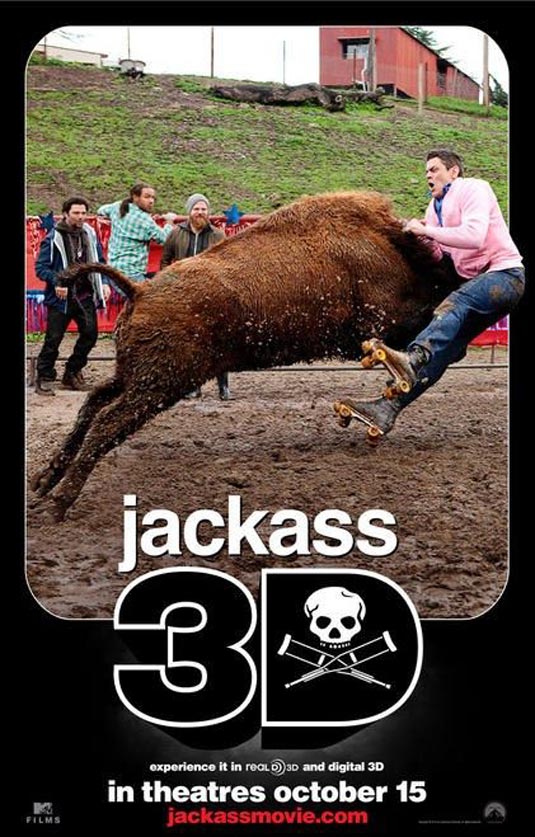
"Jackass 3D" Review

How does one review “Jackass 3D”? The tertiary installment in MTV’s prank and stunt franchise is basically immune to criticism because you get exactly what you pay for. Love it or hate it, “Jackass 3D” accomplishes just about everything it sets out to; in effect, Johnny Knoxville scores a goal on an empty net.

I am the anomaly, but I’d wager next to no one is ‘on the fence’ about whether or not they should see this film. They either contributed to the massive $50 million opening weekend box office cume, or they immediately dismissed it. In my case, however, having never seen the “Jackass” films wasn’t a conscious snub. Believe it or not, there just always seemed to be something better to watch.

But mine’s not a high horse. I sought out and watched “Jackass” and “Jackass: Number Two” the week prior to my first theater experience with the series, and I’m glad I did. After all, I grew up on “America’s Funniest Home Videos” and throughout high school religiously followed the English hidden camera show “Trigger Happy TV.” “Jackass” isn't as clever as the latter, but by measure of unbridled chutzpah, Knoxville and Co. are the reigning kings.

Like a Victorian freak show or museum of oddities, the often self-destructive experiments of the “Jackass” crew are the guilty pleasures of our generation. There’s something almost gladiatorial about watching the elaborate dangers these brave idiots subject themselves to. Man vs. bull, man vs. mule, man vs. man—our fascination with competition, spectacle, and injury is nothing new.

“Jackass 3D” being my first chance to observe others' response to these shenanigans, I was most amazed by the two-pronged reaction the audience had to the physical trauma the performers sustained. A given stunt would be executed, typically resulting in its participant doubling over in pain. The crowd laughed, as they’d been cued to. The film would then play back the moment in slow motion and suddenly everyone would groan or sharply inhale. Though we paid to laugh at people injuring themselves, what’s more interesting is our ability to empathize with the depiction of human pain. That the “Jackass” films achieve both is not an insignificant feat.

This isn't the definitive “Jackass” experience, however. Having watched all three films in the span of a single week, I did discern a distinct arc that left me somewhat letdown with Knoxville’s most recent effort. “Jackass: Number Two” improved upon the original with a more polished, professional look, and more elaborate and inventive stunts. It gave the genuine impression that the crew was pushing its boundaries and trumping itself wherever possible. That same sense of pioneering is largely missing from “Jackass 3D.” The glasses-gimmick seems to supplant genuine innovation in their routine, and on the whole it feels slapdash in comparison to the conceptual genius of its prequel.

But what survives in “Jackass 3D,” and what ultimately endeared me to the franchise is its creativity. Where it won me over was not in the painful payoff of each trick, but rather in the setup. The use of the camera to disorient, spotlight, and surprise is what really makes the series sing, and the trilogy is full of epiphanic moments of hilarity. “Jackass” has and always will be a potpourri of comedic elements, not all of which directly appeal to my specific sensibilities, but the variety is essential and the whole is somehow more than the sum of its parts.

I only wish “Jackass 3D” had more of the entrepreneurial spirit that so distinguished the second film. It may not be ambitious, but hey, a goal made on an empty net still counts.

3.5/5

Tuesday, October 26, 2010

"The Town" Review

Simple, focused, and perpetually entertaining, Ben Affleck’s “The Town” plays like the best Michael Mann film in years. It stands apart in the summer spectrum, maybe because the MO for action in 2010 seems to so heavily favor high concept; Affleck’s second directorial effort is like a breath of fresh air.

But how could he hope to score the fickle fanboys’ attention without the dream-spelunking of “Inception,” the gratuitous violence of “The Expendables,” or the retro gaming nostalgia of “Scott Pilgrim”? For one, he sidestepped those direct competitors by releasing his film on the very last Friday of the season. Second, he instilled the film with one vital element the other three lack: heart.

Sure, “Pilgrim” is a romance, but the relationships in “The Town” resonate on a deeper level. Affleck plays protagonist Doug MacRay, a brilliant bank robber who becomes romantically involved with one of his prior hostages against his better judgment. Claire (Rebecca Hall) recognizes neither his face (which was masked during the theft) nor his voice. The scenario makes for an inherently suspenseful courtship, playing our desire to see a ‘happily ever after’ against our knowledge that Doug cannot sustain his lie indefinitely.

Grounded by the simple, relatable contrast of Doug’s optimism for a brighter future and his dim present, “The Town” is free to alternate between elaborate heist sequences and intimate conversations. It works because Affleck understands what so few filmmakers seem to: that something real needs to be at stake for our characters. For Doug, it’s his relationship. For his buddy James Coughlin (Jeremy Renner), that risk is hard jail time; the character has already served nine years.

We care about these people, and it is for that reason the action sequences deliver. There may not be anything as impressive as in the final forty minutes of “Inception,” or as many explosions as “The Expendables” was packing, or even the creativity of “Scott Pilgrim,” but Affleck outshines them all with straight good storytelling and classic one-upmanship.

There are three heists in “The Town,” each more elaborate than the last. Costumes play a major role in all three, ranging from clichĂ© (skeleton masks) to bizarre (nun habits) to ingenious (Boston police uniforms). In terms of suspense, Affleck expertly paces himself. The first heist leads to Doug’s involvement with Claire, whose relationship ups the stakes for a considerably messier second outing. It devolves into a citywide car chase with the police and FBI in hot pursuit. The tension is ratcheted even higher for the final heist, which takes place at a locale described as the “Cathedral of Boston” and concludes with the largest, most visceral action scene in the movie.

My gripes are few and far between. “The Town” does feel perhaps a little longer than it needs to, and the outcome of Doug’s last job and his relationship with Claire feels somewhat inauthentic by comparison to the pragmatic whole. Nevertheless, neither issue amounts to more than a minor grievance, and Affleck concludes the film on a beautiful, somber moment that emphasizes his strength as a director.

“The Town” is one of the most pleasant sleeper surprises of the year. Like Anton Corbijn’s “The American,” it offers a grown-up alternative to action, a compelling cast of characters, and confident filmmaking. That Ben Affleck, who was once a punchline in comparison to his accomplished buddy Matt Damon, has emerged so triumphantly as a director in the past three years is a development few if anyone saw coming. Both his vision for this film and his performance therein are incredible, and “The Town” is the best, most compelling action film of 2010.

Whatever project Affleck takes on next, his ability to perpetually entertain isn’t going to expire anytime soon.

4/5

Monday, October 25, 2010

"Red" Review

“Red” is bland. Jilting its vibrant namesake, director Robert Schwentke’s pallid comic book movie is about as exciting as a grayscale rainbow. It’s a self-celebratory slog and one of the longest hour and fifty minutes I’ve spent at the movies this year. In my defense, its trailer was a calculated work of CIA-level deception—each moment is expertly chosen to give false impression that the whole is mindless fun. But mindless fun is only half right.

There’s next to nothing to say about a film this unremittingly boring. I’d stop just short of calling it a failure, but the most incredible thing about “Red” is that such a lackluster script attracted such high-profile talent.

The cast, including Bruce Willis, Morgan Freeman, John Malkovich, Helen Mirren, and Mary Louis-Parker, along with Karl Urban, Brian Cox and Richard Dreyfuss, speaks for itself. That’s part of the problem. “Red” relies too heavily on big names to make the material pop rather than directly addressing the many problems with its confusing, amorphous screenplay. Surely it seemed like a pretty safe conclusion—I’m as surprised as anyone that a film this stacked could be so completely devoid of personality.

Then there’s the not-so-insignificant fact that our leading man is the most uninteresting person in the entire film. Black ops superhero Frank Moses never lives up to his reputation—pity Willis doesn’t supply his own. His character is meant to be a “romantic” at heart, but his relationship with dopey civilian Sarah Ross is just as unconvincing. Moses isn’t a compelling protagonist—and he’s shown up repeatedly. First by Malkovich as an LSD-warped CIA retiree, but also by Freeman, who is in the film for maybe a combined ten minutes.

I’m not gunning for Bruce, though. “Red” is an amalgam of creative failures in which his is the very least offensive. It was never going to be a great film given the inept writing of Jon and Erich Hoeber, though under Schwentke’s direction it isn’t even passable. He attempts to pawn "Red" off as disposable entertainment, but reneges on the ‘entertainment’ part. It's the type of movie that squeaks by on a slow weekend, but would have been justly ignored had it been released three months ago.

Even its music is egregious. Not since Soderbergh’s "The Informant!" has a film been so tonally altered through soundtrack and score. Composer Christophe Beck imbues each languid scene with a false sense of energy—be it bouncy, comedic accompaniment or nondescript action orchestral—but he fails to make a case for them. In fact, his music underscores the dichotomy between sound and sight; he makes us acutely aware of what we should be feeling, but aren’t.

Collectively, “Red” is one massive miscalculation: criminally overlong and underwhelming given the caliber of talent on hand. There’s no reason why this shouldn’t have offered the same breezy fun as “The Losers” and “Knight and Day” did earlier this year, flawed though they were. Schwentke attempts to mend a Humpty Dumpty script by infusing it with style and enunciating its humor, but the former comes off as gimmicky and the latter is a series of embarrassing air balls. Joke upon joke was met with stifling silence from the crowd.

"Red" is one of the most colorless films in recent memory. In it, the acronym ‘R-E-D’ stands for “Retired; Extremely Dangerous,” but I’ve come up with an abbreviation that far better describes the experience: “Reclining; Extremely Disappointed.”

2/5

Sunday, October 10, 2010

"Enter the Void" Review

One thing’s for sure, you won’t leave Gaspar NoĂ©’s “Enter the Void” with comparisons ready. More than likely, you won’t want to think about it at all. Over two and a quarter hours, the film hijacks your consciousness like a potent hallucinogen, and leaves you feeling burnt out and brain-fried on the other end.

Is it worth the trip? Yes, with an asterisk. After all, the opportunity to see something this flagrantly original comes but once in a blue moon, yet it isn’t the sort of experience many will enjoy having. “Enter the Void” begins with a strobing title sequence that explodes into a first person account of drugs and death in Tokyo; it ought to come with a seizure warning. Compounding matters, almost every scene is designed to look like one continuous shot, with the camera being placed either behind our protagonist Oscar’s head, or behind his eyelids. As if the pulsating neon lights weren’t enough, we’re also subjected to the split-second blackouts of Oscar blinking.

Visually, “Enter the Void” is unlike anything I’ve ever seen, but it sure ain’t perfect. The problem, bluntly, is its amorphous, front-heavy structure. The first half plays out conventionally enough, beginning with what we assume is the end, and playing flashback catch up to contextualize the subsequent events. We arrive back in the present to neatly tie the knot, only to discover that NoĂ© isn’t remotely close to finished telling his story.

Where he takes “Enter the Void” in its ethereal second half is actually pretty fascinating, conceptually. However, it feels like an entirely different film. NoĂ© floats aimlessly back and forth across Neo-Tokyo (to support the ‘one shot’ aesthetic, he rarely cuts directly from one location to another, often necessitating that the camera move through walls and entire buildings). The film really wears its premise thin during this overlong stint, though the last twenty minutes mostly redeem it.

The conclusion is a little predictable given that the characters seem to be arbitrarily engrossed by the Tibetan Book of the Dead, but it works because it boils “Enter the Void” down to its visual core. Somewhere along the way, the lines of the narrative are obliterated and NoĂ© takes a hypnotically beautiful and bizarre psychosexual detour that bridges the gap to his ending nicely.

In retrospect, it’s easy to remember the curious power of its final moments and marginalize the boredom that divides it from the first, much stronger hour. The film would almost certainly benefit from a second viewing, but I’m still not entirely sure that I would ever grant it one. I seriously question how NoĂ© and his editor could stand to watch and assemble this film all day every day, because even their 137-minute finished product is a workout for the eyes. God help us if it were released in 3D.

But for better or worse, eyestrain is part of the experience, and “Enter the Void” is more an incomparable experience than a great film. It’s a shame that the vast majority of its potential audience will never even have the opportunity to see it projected, as I can only imagine home video will diminish its psychedelic impact.

The best recommendation I can make is that if, like me, you go out of your way to see distinctly different films, you’ll get your money’s worth with “Enter the Void.” Objectively, it’s hard to deny the incredible creative scope and visual audacity on display, but it’s also hard not to wish the whole thing were just a wee bit more succinct.

It ain’t perfect, but “Enter the Void” is original, and there’s no undervaluing that. Hell, I’ll try anything once.

3.5/5

Wednesday, October 6, 2010

"Let Me In" Review

Remember when vampires played by the rules? When they only came out at night and actually bit necks? Judging by today’s glowering daywalkers, respect for that mythology has been all but Eclipsed. Ahem.

Maybe that was the fear with this remake of “Let the Right One In.” Hollywood had essentially defanged the vampire, and many—myself included—poo-pooed the notion that an American remake of a brilliant foreign film could be anything but fast-food imitation. Fortunately, we were dead wrong; Matt Reeves’ “Let Me In” is the rare sequel worthy of its original.

Still, it’s peculiar timing. Tomas Alfredson’s 2008 Swedish version is barely in the ground, less than two years old, and its English-language retelling is already in western theaters. And it appears mainstream westerners still aren’t interested; even sans subtitles, opening weekend box office returns were abysmal, evidence at least that they didn’t gratuitously sex it up.

Sexuality has been intimately linked with vampire myths for hundreds of years, but part of what made “Let the Right One In” so fascinating was the way it turned all that on its head. Seduction and lust had long been the vampire’s tool and victim’s vice, respectively; conversely, the film—based on a novel by Swedish author John Ajvide Lindqvist—illustrated an uncommonly innocent, romantic vampiric relationship. It’s the heart of the story, and a brilliant creative stroke that survives its Americanization unscathed.

That success is due in no small part to an equally talented young couple in the lead, this time Chloe Moretz—who, between “Let Me In” and her turn as Hit-Girl in “Kick-Ass,” has had one hell of a year—and Kodi Smit-McPhee, who impressively costarred alongside Viggo Mortensen in the 2009 adaptation of Cormac McCarthy’s “The Road.” Films about kids can be a risky proposal, but Moretz and Smit-McPhee subtly convey their ability to create authentic young characters.

The evolution of Moretz is particularly impressive. Many so-called ‘child-stars’ burn out hot and fast because they allow themselves to be typecast as a child. Moretz, on the other hand, seems to have futureproofed her career by never committing to a specific genre, and by never shying away from more adult fare. Though she always plays a child, most of her characters are not childish; we have no trouble seeing her already as a young woman—Or a centuries-old vampiress, as the case may be.

Beyond the performances, Reeves’ version is as solidly constructed as Alfredson’s. The pacing is deliberately slow, which can make either feel disengaging at times, but only if you’re already well acquainted with the plot of the other. Likewise, I found myself roundly less enthralled by “Let Me In,” if only slightly, because of my familiarity with the Swedish film. Neither is perfect, but despite a slight edge to the original in the subtlety department, the two films are practically interchangeable. “Let Me In” is like a good cover or acoustic version of an already great song.

Both versions are alike in their minimalistic framing, and to air one minor gripe the two share, they both feature ugly CG effects that mar certain moments. In “Let Me In” Reeves pulls back during action sequences to showcase just how fast his vampire moves, but instead of being disturbing, it comes across cartoony. The style juxtaposes the atmosphere of restraint he builds elsewhere uncomfortably. In a film this slow, he really has to nail the spikes, and he isn’t always successful.

Nevertheless, “Let Me In” is still a firm reminder of what the genre is capable of when treated maturely. It’s a shame that vampires have become popular as such silly caricatures of their former selves—the resounding thud of this film tanking will likely ensure it stays that way. As it turns out, it’s hard to win when you’re the only one playing by the rules.

3.5/5

Friday, October 1, 2010

"Jack Goes Boating" Review

"Jack Goes Boating", above all, is indistinct. My memory of the film isn’t yet a week old, and already the transience of its impact has set in. If the script, based with painful obviousness on a stagnant stage play, was really the material that made Oscar winning actor Phillip Seymour Hoffman want to throw his director’s beret into the ring, surely I must be missing something.

"Jack Goes Boating" doesn’t have an ounce of creativity, which is a shame because Hoffman honestly shows promise as a director, and the performances of his entire cast are superb. The unfortunate inevitability in following bum blueprints is that the whole thing collapses.

The mediocrity that practically oozes from its pores is enough to gag a man on scent alone. The undue theatricality of the writing is heightened by a fact that becomes obvious painfully early: you know exactly how it’s all going to turn out. Worse yet, you’re stuck watching the world’s two least articulate people fumble their way around their love for one another. Though to be clear, the film is by no means bad cinema. Hoffman, who plays the title role in addition to directing, has a great, subtle chemistry with his co-star Amy Ryan; a chemistry that’s completely wasted on a story as sharp as safety-scissors.

The plot, insofar as one exists, revolves around two modern couples living in New York City. The first (John Ortiz, Daphne Rubin-Vega) are married and appear to have it great. They introduce the second, their two awkward (or is it only?) friends, on a blind date. Hoffman and Ryan’s characters share a dinner during which neither appears to be having a good time, though both are apparently lonely enough to consider it a mild success.

And so the film tediously prattles on, drawing a heavy-handed comparison between the crumbling marriage and the fledgling courtship. Interspersed with these scenes are subplots where Jack learns to swim and cook, and Ryan’s character, Connie, deals with sexual harassment in the workplace. The entire film dovetails into an expectedly tumultuous climax, where everything can and does go wrong for our two couples before crescendoing into fifteen minutes of self-aware shouting that highlights its source material so transparently that you can practically see the stage.

Thankfully, the performances are opaque. Hoffman isn’t exactly challenging himself; he’s played broken, socially inept sweethearts on more than one occasion before, but it’s a character archetype he excels in. Ryan is as delicate and sympathetic as his companion, and we really do want things to work out well for them (even though that seems to be a foregone conclusion). Meanwhile, Ortiz and Rubin-Vega’s portrayals of Jack’s bourgeois acquaintances work on a performance level. Both feel authentic, but are ultimately sabotaged by their storyteller, who appears to have less understanding of them than they do.

"Jack Goes Boating" is another testament to the power of the screenwriter, in this case, to spoil everything great a film has going for it. For my money, Hoffman is one of the greatest actors working today, and he asserts himself here as a confident purveyor of images. The problem is, he chose weak material.

Though I hope he directs again, I question Hoffman’s taste as a storyteller. Perhaps he was just sharpening his creative knives for something juicier, but the memorable moments in "Jack Goes Boating" were few enough to have already been jettisoned from my consciousness.

Its impact may have dissipated, but first impressions last a lifetime. Here’s to hoping Hoffman’s next effort lives up to his talent.

2.5/5

"The Social Network" Review

The genius of “The Social Network” begins with the story that inspired it. The tagline on its poster, “You don’t get to 500 million friends without making a few enemies,” perfectly conveys the inherent dramatic irony; royal narcissist Mark Zuckerberg is today the champion of the web’s most popular socialization tool, Facebook.

It’s rich soil for screenwriter Aaron Sorkin, who imbues the material with his signature wit and a searing theatricality. Frankly, I’m not concerned with what small liberties his brilliant script took along the way—Not that even the most obscene inaccuracy could stymie the momentum he builds. The film is guiltier of embellishment than falsification, a crime for which he and director David Fincher should be awarded our highest praise. Fincher knocks this one out of the park with confident cinematography, nuanced performances from his cast, and layered storytelling that lends the film its surprising depth. On its surface, “The Social Network” is funny, brisk, and compelling, but underneath, it’s near rotting with angst.

Its moodiness and purposeful visual melodrama are its most unique assets. Fincher approaches the story from the position of Zuckerberg himself, striving for the honest emotional experience of each scene, with all the grandiosity of a nineteen year old’s perspective. To the layman, that means he finds a way to make sitting at a computer, or having a conversation in a crowded nightclub seem invigorating and fresh.

“The Social Network” is immediately in contention as his best film, but as much as Fincher brings to it, the lion’s share of the Mark Zuckerberg experience is etched in the long, perpetually unsmiling face of Jesse Eisenberg, who portrays him in the film. Eisenberg has a history of taking on lighter roles in comedies like “Zombieland” that has prompted some to unfairly label him “the poor man’s Michael Cera,” (though the comments seem to stem from Cera bashers themselves—There’s no pleasing those guys). Eisenberg’s turn here should slap the cynicism from any remaining doubters’ mouths. He owns the role; the callous calculation, the condescending sense of humor, and the introverted inner pain are expertly realized, and yet the true testament to Eisenberg is that Zuckerberg at his worst is a character impossible to truly hate.

And Eisenberg is matched by a cast of equal talent; Andrew Garfield plays Facebook’s co-founder, Eduardo Saverin, and Armie Hammer plays both of the Winklevoss twins, who together bring suit against Mark for intelligent property theft. The beauty of each character is that despite their muckraking in the deposition room, which acts as a framing device in “The Social Network,” none ultimately feels like the antagonist. As with the best cinematic scuffles, we indentify with both sides.

But as beautifully as the stars aligned for what is insofar the best film of 2010, “The Social Network” is somehow more than the sum of its parts. Its underlying themes of capitalist corrosion and the price of success are made all the more poignant given the age of its participants. Fincher has jokingly referred to the film as “The Citizen Kane on John Hughes movies,” but he honestly isn’t far off. Young love, rebelliousness, arrogance, and burgeoning identity play major roles in shaping the behavior of Sorkin’s characters.

And yet, for all their bitterness and hostility, “The Social Network” is still an exciting, encouraging film. Somewhere beneath the veneer, alongside the greased cogs in its innermost workings, the power of Mark’s idea gestates. Facebook, as silly and as trivial a subject as it may seem, is for many an essential communicative hub in their day-to-day lives. Watching Zuckerberg succeed beyond his wildest dreams, literally bringing strangers together while pushing his friends away, paints an oddly optimistic portrait.

The future for the internet generation seems bright in Fincher’s mind. Even as we make the gradual shift to living our lives electronically, even when we’re polluted by a consumer culture, and even when we lose sight of our humanity, some kid can still change the world.


5/5

Tuesday, September 28, 2010

"Wall Street: Money Never Sleeps" Review

You don’t exactly need to see the sequel to “Wall Street” to comprehend how completely the market has changed in the past twenty years—Watching the original film today makes that more than apparent. It’s still a fascinating time capsule from 1987, almost a work of science fiction now. Cue Rod Serling—“Imagine, if you will, a world in which the greatest economic hazard is making too much, too quickly.”

But greed is not the antagonist in “Money Never Sleeps.” Debt is. Gordon Gekko (Michael Douglas) is released from prison after an eight-year stretch for insider trading only to discover that his money now torments him in its very absence. Picking up in 2008, the entire cast of affluent characters in the film is haunted by the global economic crisis and even more intimate money matters.

Shia LaBeouf plays Jake Moore, a trader who invests his million-dollar bonus the night before the market collapses, just after buying an extravagant wedding ring to propose to his girlfriend, Winnie Gekko (Carey Mulligan). After Moore gets the opportunity to speak with his new father-in-law, the two begin a series of unorthodox transactions; Gordon wants an opportunity to get closer to his estranged daughter, which Jake orchestrates in exchange for the opportunity to further his career.

In that way, “Money Never Sleeps” follows a similar template to the original, with Gekko acting as protĂ©gĂ© to a young, cutthroat trader. The sequel, however, has a more ambitious, branching story and what feels like a much larger cast. It suffers somewhat for its sprawling narrative, but the film is grounded by a strong emotional center. “Wall Street” is still the more rousing film, but “Money Never Sleeps,” is appropriately more dour, downbeat and moody; the films are alike only in their committed reflection of their respective economic climates.

Both “Wall Street” films seem to find Oliver Stone at his most experimental. His multimedia gimmickry doesn’t always work, but he never seems to be at a loss for a new way to present information. “Money Never Sleeps” paints the stock market index across the New York skyline, fractures into split-screens, and cedes itself entirely to illustrated figures that would seem more at home in a documentary. Stone can sometimes be a frustratingly predictable director, and small flourishes like these are what make the “Wall Streets” stand out in his filmography.

But viewer beware, for all its stylishness, “Money Never Sleeps” will bore many. It is an uncompromisingly slow film, especially in its drooping middle—devotees of the fast-paced original will be particularly let down. But while the clock-check quotient is relatively high in places, I believe it ultimately reaches a satisfying payoff.

After all, what makes these films tick is their characters, and this sequel is no slouch. They make not be as vibrant or distinct as the people who populated the 1987 film, but again, they have to support a modern disillusionment with the market that didn’t exist back then. The characters in Stone’s original are eccentric, quirky, domineering, and vivacious. The characters in “Money Never Sleeps” are sullen, worn, and scared.

And then there’s Gekko. It’s interesting that Douglas’ portrayal of him is the most enduring part of the original film; but then it’s obvious when you see him as that character. He is capitalism, a physical manifestation of it. Douglas owns the performance, and though Gekko has been beaten into a shell of his former self in “Money Never Sleeps,” he’s still plain fun to watch. The charisma is there, and Douglas supplements a terrific irony to the character in playing him broke. “Bet you don’t have one of these,” he boasts to Moore during their first encounter, flashing his NYC MetroCard.

“Money Never Sleeps,” for better or for worse, is the “Wall Street” our generation gets. It’s a time capsule from 2010, an imperfect but equally relevant window into our languishing economy. In twenty years, we can only hope it all looks like science fiction.

3.5/5

Tuesday, September 21, 2010

"Devil" Review

The most menacing shadow in “Devil” is that cast by its producer, M. Night Shyamalan. The perceived decline in the quality of his work has eroded public praise into apathy and apathy into contempt over the course of his downhill career. Things have gotten so ugly for the once (briefly) untouchable filmmaker that I wonder how the reaction to “Devil” might have changed had he divorced his name from it completely.

Written by Brian Nelson (“30 Days of Night,” “Hard Candy”) and directed by John Erick Dowdle (“Quarantine”), it stands to reason that M. Night, after pitching the idea and relinquishing creative control, would have receded into the background. The problem, I think, is that Shyamalan’s fingerprint is still so clear on the final product. Psychologically speaking, I suspect many are dismissing it purely by association.

And to be clear, there are perfectly valid reasons to dismiss “Devil,” but Shyamalan isn’t one of them. He did his job; the premise is solid, and the building blocks of the story are, for the most part, rightly placed. Its blemishes, therefore, would be more aptly laid on Nelson and Dowdle’s shoulders. While the work of either is only seldom outright bad, their collaboration is never better than average.

It’s their fault that “Devil” never gets under our skin, and the most obvious explanation is because half the film takes place outside the elevator, where a second storyline and protagonist divide audience attention. No doubt that dynamic existed in Shyamalan’s original outline, but Nelson and especially Dowdle seem to favor it and Police Detective Bowden’s (Chris Messina) attempts to break into the jammed elevator over its five passengers’ attempts to break out.

As a result, the claustrophobia never sets in. The viewer never feels trapped because, narratively, they’re being transported to safety every five minutes. Dowdle also fails to demonize the elevator to the extent it really should be. Instead, he focuses on painting the entire building his antagonist, drawn against dark storm clouds and introduced in an ominous upside-down aerial shot. It’s a noble attempt, but it’s no small feat to conjure dread from a flat piece of reflective modern architecture.

For Nelson’s part, he runs with probably the worst idea of anyone by forcing all the ‘devil’ exposition out of a cringe-worthy (but thankfully short-winded) Catholic maintenance operator (Jacob Vargas), who unconvincingly persuades Bowden to consider the supernatural element at play. The character also narrates.

They may seem like minor gripes, but somehow, the individual misfires of Nelson, Dowdle, and Shyamalan add up to more than the sum of their parts; they comprise a film that is almost entirely unaffecting. “Devil” works, but it works the way an imitation Walkman works, which is to say, not very well. The whole thing has a plastic, perfunctory feel to it.

Still, “Devil” isn’t such a bad little flick. It was made on a $10 million shoestring, runs only eighty minutes, and still delivers on its premise with the benefit of established filmmakers behind it. It’s unclear how quick their production cycle was, but be it time, budgetary, or creative limitations, it’s a shame neither screenwriter nor director shine through. Ultimately, it might as well be a Shyamalan film, though I think even his most pink-faced detractors will agree “Devil” isn’t half as bad as “The Happening.”

Shyamalan’s fall from grace has been almost on the level of a political scandal; people now recognize his name and boo it. I suppose some of that hostility is warranted when you disappoint people as consistently as he has, but I can’t help but wonder how warranted his latest critical lashing has been.

“Devil” is far from a perfect film, but M. Night is the least of its concerns.

3/5

Wednesday, September 1, 2010

"Life During Wartime" Review

Todd Solondz might be the most polarizing comedy director no one’s ever heard of. The reputation of his films proceed them; a shroud of controversy seems to surround his work, which frequently depicts explicit sexuality, including pedophilia and rape, not to mention murder, exploitation, and ridicule channeled through a pitch-black misanthropic irony. And yet you might as well be speaking another language bringing up his name and filmography with a mainstream crowd. Even in the circles in which he’s known, his sense of humor is a decidedly acquired taste. So specific, in fact, that his latest film, “Life During Wartime,” may come as a shock to his fans. And not the sort of shock they’re used to.

A direct follow up to probably his most well known film, 1998’s “Happiness,” “Life During Wartime” provides a notably more contemplative take on the lives of Solondz's characters, who have been deliberately and entirely recast for this sequel. Yes, it has its moments of biting humor, dark caricatures, and discomfort, but this time around, he approaches them with a subtler, more refined eye. “Happiness” is a busy, sprawling movie—“Wartime” is a brief string of conversations reactive to the action of that film.

It has the tendency to come off initially disappointing, perhaps because it is his least funny film. But if it is his least funny film, then it is intentionally so; for a director who has tirelessly redefined the term ‘mature content,’ Solondz finally feels as though he himself is maturing. The result may be less fun, but it’s probably more valuable.

And his characters breathe that maturation. In “Happiness,” Bill Maplewood (then Dylan Baker, now CiarĂ¡n Hinds) is a struggling pedophile; he is defined and condemned by the things he does. His reintroduction in “Life During Wartime” is upon release from prison, where his sole motive is to track down his son and conduct an amateur psychoanalysis on the damage his behavior caused. Hinds is solemn and introverted in the role; Baker was oily, narcissistic, and well—Childish, if you’ll forgive the phrase.

Maplewood’s recurring dream is a perfect visual metaphor for not only the changes he has undergone between films, but the tones of the films themselves. In “Happiness,” he dreams of an unspoiled park, complete with picnickers and strolling couples enjoying absolute tranquility—Before he loads an assault rifle and lays them all to waste. In “Wartime,” Maplewood revisits the park, where a single elusive individual, scrubbed and out of focus, turns to him with a rose in hand.

What I find most interesting, however, is not the way Solondz reconsiders these characters, but how he reconsiders the idea of the sequel. He’s dabbled before in casting multiple performers in a single role—His last film, “Palindromes,” had eight actresses portraying its protagonist. But with “Life During Wartime” he commits entirely, while at the same time creating a film purposefully asimilar to the existing work.

It may not be as exciting or as groundbreaking a film as “Happiness” is and was, but it’s more interesting for its reservations. The converse, ‘Hollywood’ approach would have been to outdo the original, to push the envelope even further, and the result would be infinitely less genuine. Instead, Solondz throws a curveball: treating his characters with unprecedented compassion (though only by comparison to his other films), and challenging our preconceived notions of both what a sequel is, and what a Todd Solondz film is.

“Life During Wartime” won’t win over many detractors (they probably haven’t heard of it anyway), and it even runs the risk of aliening fans expecting more vitriol—Leave it to Solondz to polarize audiences even when his shroud of controversy dissipates. The man has an absolutely uncompromising vision, and he’s still one of the greatest comedy directors working today, whether you’ve heard of him or not.

4/5