Monday, April 11, 2011

"Your Highness" Review

Well, that was disappointing. "Your Highness" turns out to be a juvenile letdown of epic proportions. You needn't look further than the title to glean the intellectual extent of its pothead-pandering humor, which wholly lacks the tragic undercurrent that made co-writers Danny McBride and Ben Best's equally crass HBO endeavor "Eastbound and Down" such a success.

The pair's medieval genre mashup fails by comparison. Even doled out to a stacked cast that includes McBride, James Franco, Natalie Portman, and Zooey Deschanel, the jokes often read like fairytale MadLibs filled in by a gaggle of stoned teenagers. If your idea of incisive comedy is the suffix "motherfucker" to a line of dialogue, or hearing the Oscar-endowed Ms. Portman say the word "beaver," then ready your funny-bone for one gut busting adventure.

For the rest of us, "Your Highness" only occasionally tickles. Lowbrow humor has its place, but Best and McBride make it the star attraction. Their focus clearly isn't on the plot, which serves only to carry our reluctant hero from one set piece to the next, each accompanied by a handful of easy gags. First we meet a pedophilic puppet (har har) and later a minotaur with a third horn, if you catch my drift.

Thanks to some welcome practical effects, the fantasy characters and locales actually carry audience interest better than the one-note humor. Director David Gordon Green borrows from a stable of genre classics, and "Your Highness" features shades of Jim Henson and Ray Harryhausen, among others. Given that aesthetic acuity, it's a shame so much of the running time is eaten up in a nondescript forest. The most absorbing visuals end up being somewhat few and far between, and at over 100 minutes, that leaves plenty of lulls.

And yet "Your Highness" is rarely an outright bore. It has a tendency to drag, and though the jokes often skew to the lowest common denominator, it's easy enough to fall into its dumb rhythm. I'd be remiss not to mention that Best and McBride elicited a handful of laughs from me, though batted well below 500. "Your Highness" isn't a strikeout for the pair—it's more of a foul tip. McBride's is a career treading water, and instead of expanding upon the emotional facet of "Eastbound," he merely transplants his Kenny Powers persona to the middle ages.

Don't get me wrong—I'm usually the one to defend comedians accused of role redundancy, and I'm far more disappointed in McBride the writer than I am in McBride the actor. But where elsewhere he blends his crudity with offbeat social commentary, in "Your Highness," he and Best aren't even trying to be edgy—comedically or otherwise. The laughs are cheaply won, and the plot doesn't elevate its archetypical underpinnings. Naturally, the intention was to create an unobtrusive framework for the gags, but then when the gags fail, the audience is left with no backbone of appreciation for the protagonists or the quest at hand.

"Your Highness" isn't a terrible comedy, but it is a disappointingly transient one—especially given the aggregate talent on hand. Everyone involved has been funnier elsewhere, though blame ultimately lies with Best and McBride. Their stab at adults-only fantasy earns its R rating, but without challenging a single convention or bringing one genuinely new idea to bear. That is, unless you count plugging profanity into an otherwise nondescript conversation. Motherfucker.

2.5/5

Sunday, April 10, 2011

FARCE/FILM Episode 87: Your Highness


00:00 – Intro
01:22 – Top 5
06:13 – Main Review: Your Highness (2011), dir: David Gordon Green
26:38 – WMD

(The Wire, Catfish, Glee, Dexter, Brick, Assassination of a High School President)
01:10:16 – E-mail and Outro
(Guilty Pleasures, MPAA ratings)


Your Highness
Colin:
Laura:
Crawford:
Micah:

Wednesday, April 6, 2011

"Insidious" Review

Hollywood horror films draw from a grab bag of assorted Halloween party favors, but amidst all the cheap plastic spider rings, director James Wan inserts a tarantula or two for good measure. His latest, "Insidious," takes a see-what-sticks approach that can sometimes be as frustrating as it is refreshing, but in a cinematic climate where scary movies are becoming an increasingly on-rails experience, every goose bump is worth its weight in gold (and I imagine it adds up).

"Insidious" has plenty of genuinely chilling moments, and makes better than average use of the oft maligned 'jump scare.' The technique doesn't always deliver the desired impact, but that such instances are uneven in effectiveness is in a way an incredible asset. Emotionally, we're on our toes. Wan puts convention in a blender and the audience is often left reeling from the topsy-turvy inertia. That familiar horror guardrail is gone and we're left groping in the dark.

Taking a page from Sam Raimi (not to mention title work more than a little reminiscent of his 2009 flick "Drag Me to Hell"), Wan keeps us off-balance with unpredictable emotionality. Not every bizzaro changeup he pitches lands squarely in the strike zone—a bumbling pair of paranormal investigators falls flat on the comedy front—but by constantly upsetting our expectations, "Insidious" picks a cerebral scab and burrows under our skin. A particularly inspired and disorienting soundtrack choice is the use of Tiny Tim's "Tiptoe Through the Tulips," proving perhaps definitively that nothing is more terrifying than a ukulele.

Little unconventional details help too, and with credit to "Saw" screenwriting veteran Leigh Whannell, "Insidious" makes some subtly interesting choices. For once, our parental protagonists, Josh and Renai Lambert (Patrick Wilson and Rose Byrne), are not the progenitors of an only child. Creepy kids are a genre staple, but by diffusing that cliché with siblings, Whannell opens himself to some less-traveled roads. Unfortunately, one of his most glaring oversights is underplaying that idea; in the inferior second half of the film, the other offspring essentially disappear.

Or take, for instance, the critic's ace-in-the-hole: "Why don't they just leave the house?" Like in "Paranormal Activity," Whannell explicitly explains that the demonic presence is attached to his characters rather than their homestead, but they hightail it out of there all the same. I can't immediately recall another example of haunted protagonists rationally raising stakes in the middle of the second act.

It may seem insignificant, but it makes a big difference in a genre as delicate as horror, where the element of surprise is everything. If "Insidious" were comprised entirely of offbeat innovations, it would be a perfect film. But just as often, Whannell lets convention get the better of him, or he piles on too many sub-genres—what starts off in "Poltergeist" country winds up closer to "A Nightmare on Elm Street," if you can imagine that. The disparate elements clash and complement each other in equal measure.

Spearheaded by Wan and Whannell, the "Saw" franchise pushed horror in a new direction. "Insidious" nudges it back. Inspired by classic seventies spook-outs, the filmmakers crafted what feels like Hollywood's most synonymous effort in years, imperfect though it may be. There are no hidden camera gimmicks, and absent is the also oft maligned 'torture porn' the pair popularized eight years prior. Instead, expect to be treated to the unexpected. True, the beats and "Boos!" are familiar as can be, but when "Insidious" jumps the rails, it's one hell of a ride.

3/5

Tuesday, April 5, 2011

FARCE/FILM Episode 86: Insidious, Source Code


00:00 – Intro
01:51 – Top 5
03:42 – Additional Review: (spoilers) Source Code (2011), dir: Duncan Jones
26:30 – Main Review: Insidious (2011), dir: James Wan
43:41 – WMD

(Minority Report, Everything You Always Wanted to Know About Sex, Laura, Never Let Me Go)
59:34 – E-mail and Outro
(Favorite Clint Eastwood role and Whiskey)


Source Code
Colin:
Kevin:


Insidious
Colin:
Jon:
Suman:

Friday, April 1, 2011

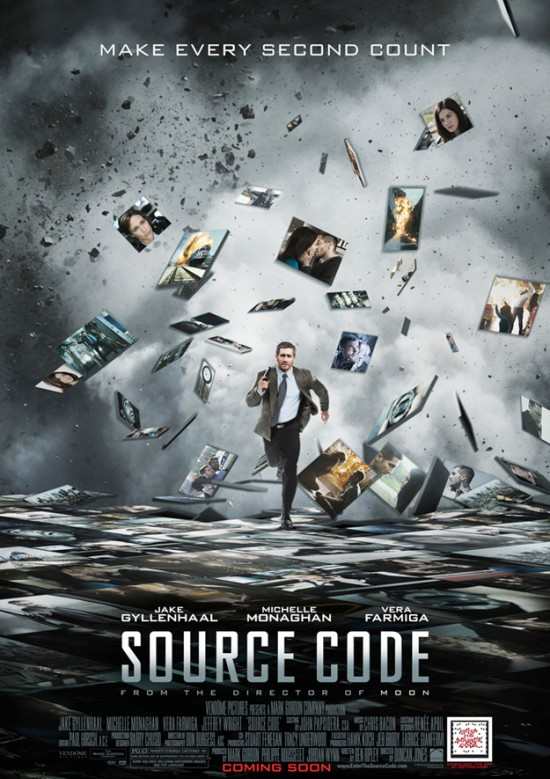
"Source Code" Review

"Source Code" isn't even vaguely plausible. I try not to overthink sci-fi spitballing, but even the most preposterous premises should adhere to an implicit rule set. Based on a screenplay by Ben Ripley, who previously authored two direct-to-DVD "Species" flicks, this lazy follow-up to director Duncan Jones' understated 2009 character study "Moon" is a major disappointment.

Steeped in pseudo-science, "Source Code's" biggest fault is its failure to adequately explain the parameters of the titular alternate reality experiment. Through vague governmental computer wizardry, Army Capt. Colter Stevens (Jake Gyllenhaal) is uploaded into the body of a civilian aboard an ill-fated Chicago-bound commuter train and tasked with locating a rigged explosive and its owner. To complicate matters, he only has eight minutes until impact and it's back to start.

So begins a trial and error rescue mission—not to save the train itself, but to identify the culprit and avert a looming second attack. If you're already confused, don't sweat it—Stevens is too. After every botched attempt, he finds himself back in a dank isolation room harnessed into an enormous machine with a video link to his commanding officers. As he probes them for more information on his mission, he also pries out the requisite exposition about the tech.

Long story short, Source Code isn't time travel. It merely relocates Stevens' consciousness into the lingering memory trail of the recently deceased. Cool, right? The problem is that such a heady concept immediately opens itself to a thousand potential plot holes. For instance, if Stevens is reliving the terminal eight minutes of someone's life, why can he exit the train at random when the body and mind he's sharing has no frame of reference for it? How does he even know what the passengers two cars over look like?

Even if you buy into the flawed logic of "Source Code," the filmmaking just isn't up to snuff. Jones throws subtlety to the wind for this antithetical take on the genre he seemed so passionate for two years ago. He imbues the proceedings with a nondescript glossy veneer and achieves unanimously stilted performances from his cast. Character actor Jeffrey Wright comes away looking especially bad, but Gyllenhaal is also mismanaged in the lead.

It isn't their fault; Jones lacks vision and Ripley lacks talent. The latter in particular seems incapable of executing on even his better ideas interestingly. By his hand, Stevens' lame bomb-sniffing stratagem boils down to blindly badgering suspicious-looking commuters and eventually lucky guesswork. Maybe some will respond to his common sense approach, but I much prefer watching characters more clever than myself weasel their way out of trouble. For all his military training, Captain Stevens might as well have been Joe Average Passenger.

A far cry from the careful construction of Duncan Jones' offbeat debut, "Source Code" is a discouragingly impersonal film shellacked with Hollywood disinfectant. Worse, it's plain bad science fiction. It's a halfhearted amalgam of films like "The Matrix" and "Inception," hold the fresh perspective. Still, I'm not ready to count Jones out. The young director had a hand in fleshing out "Moon," and will hopefully creatively contribute more to future projects. However, as it stands, his first two features couldn't be more at odds. Taken alone, "Source Code" is a misfire; given that it's the sophomore effort of so promising a talent, it's a major missed opportunity.

2/5

Monday, March 28, 2011

"Sucker Punch" Review

If the filmography of Robert Rodriguez were projected onto the wall of Plato's cave, the fever dreams of its sorry inhabitants might come out something like this. "Sucker Punch" is an asylum for every unoriginal impulse that strikes director Zack Snyder's attention deficient mind. It is an unmitigated disaster of storytelling—thematically diarrheic with visuals to match. This hopeless post-"Inception" melodrama isn't based on a comic book like either of Snyder's previous efforts, but every genre cliché carries over tenfold.

Like a pockmarked teen with an anime fetish, Snyder's convoluted revenge flick plays out with a cast of buxom babes who look as though they might bleed mascara when cut. Stuffed into absurdly tight-fitting outfits, gals with names like Rocket, Baby Doll, and Sweet Pea unload thousands of shells from their semi-automatic rifles and leap columns of flames in when-exactly-was-this-cool-again slow motion.

The tiered fantasy worlds of "Sucker Punch" might be exciting if they corresponded in any way to the next reality over. Probably the most asinine aspect of Snyder and Steve Shibuya's screenplay (I say probably because competition is steep) is that while our protagonist is fighting a 20-foot tall sourpussed samurai or fleeing a castle from an apoplectic dragon, we are meant to believe she is really—how should I put this—doing a sexy dance. A major structural component of "Sucker Punch" is Baby Doll's escape from incarceration, a feat that necessitates trinkets such as a map, knife, lighter, and key, all of which are obtained by distracting their male overlords with… exotic dancing.

For every item on the checklist, Baby Doll gyrates—though while she cuts loose, she imagines she is annihilating clockwork Nazi soldiers in the trenches of a steampunk World War II, or tearing apart an android army on a futuristic bomb-strapped bullet train. The latter is set to a cover of the Beatles' "Tomorrow Never Knows," in which John Lennon once sang, "Turn off your mind," and "Lay down all thought." Snyder seems to have appropriated that message quite literally.

The bigger problem is that Snyder throws dramatic tension out the window by creating a fantasy world where nothing is at stake. The laws of these alternate realities are unclear at best, and the sequences themselves are purely masturbatory given that whatever happens is only loosely tied to the story we're supposed to be following. I might be more forgiving of that conceit if Snyder really wowed, but "Sucker Punch" doesn't bring a single idea to the table that hasn't been done to death in movies or video games. Snyder does so much recycling that he ought to receive special commendation from Greenpeace.

It's equally hard to muster up sympathy for his characters outside of their imaginary adventures. Snyder has a bad habit of using trauma as a binding agent between them and the audience; other than that Baby Doll fell under the shadow of an evil foster-father before imprisonment, there isn't a single reason why we should care about her. She is as devoid of genuine personality as the rest of the cartoon cast.

"Sucker Punch" might have been a blast if the tone was more in line with "Scott Pilgrim" or even "Kill Bill." Gratuitous action can be fun—just don't ask me to take it seriously. The worst of Snyder's misconceptions is that he can simultaneously blow shit up and pull our heartstrings. That he directs schlock under the pretense of style is laid bare in this, his first original work. "Sucker Punch" is not only brain dead, it's contagiously stupid. It's a high school sophomore's juvenile doodles on an 82 million dollar budget. If Snyder's filmography were projected on the wall of Plato's cave, I think those poor bastards would welcome the first disorienting rays of sunlight and their freedom with open arms.

1.5/5

"Paul" Review

"Paul" is innocuous extraterrestrial fun, but should have been funnier given the caliber of its cast and crew. Simon Pegg and Nick Frost, the British bosom buddies who previously collaborated with Edgar Wright on genre send-ups "Shaun of the Dead" and "Hot Fuzz," pen their first screenplay, which lovingly pays tribute to a half century of science fiction moviemaking.

The target audience for "Paul" is old enough to appreciate an homage to "Close Encounters of the Third Kind" and will recognize odd dialogue torn from "Star Wars" and "Aliens," and yet much of the humor skews juvenile. For every gallon drawn from the cultural lexicon, there is a runoff of infantile attempts at comedy—Kristen Wiig as a Jesus Freak spouting tin-eared strings of mismatched expletives is one of the worst offenders.

Thankfully, with a brisk pace and a stacked cast—bit parts are filled by greats like Jeffrey Tambour and Jane Lynch—the momentum rarely falters. Pegg and Frost play the leads, a pair of English geeks on holiday to Comic-Con, one RV rental away from a tour of America's kitschiest UFO tourist traps. While on an otherwise deserted stretch of moonlit highway however, they witness an epic car crash and meet the genuine article—an E.T. colloquially called Paul, voiced by comedian Seth Rogen. Less sci-fi parody than offbeat road film, the trio become fast friends on the lam from Paul's governmental pursuers. Jason Bateman of "Arrested Development" fame makes a convincing turn as a badass man in black.

And yet for all the talent on board, "Paul" is short on funny. It's an easy hour and forty minutes, but the laugh out loud moments are few and far between. In addition to being the weakest Pegg/Frost flick, "Paul" is an equally underwhelming effort from director Greg Mottola, who previously helmed the hilarious high school comedy "Superbad" and the surprisingly poignant self-authored "Adventureland." Mottola brings a visual acuity to the proceedings, including an earnest prologue that recalls the Spielbergian charm of yesteryear, but such stylistic flourishes are ultimately abandoned in favor of conventional comedy over-lighting.

"Paul" never really feels like Mottola's film. He does manage to elevate Frost and Pegg's material from a directorial standpoint, but too often it's all too apparent that the authors are but fledgling storytellers. Occasionally, their lack of traditional screenwriting experience works to their advantage, and their offbeat sensibility is part of what makes the film endearing in spite of its flaws. Rather than embrace their status as Hollywood outsiders however, Frost and Pegg attempt to emulate American studio output. The result is an unusual comedy worth seeking out, but one with a serious identity crisis on its hands.

Hit and miss high jinks and bipolarity aside, Frost, Pegg, and Mottola are having too good a time to harp incessantly on where they went wrong. Gifted creatives all, even their lesser successes are more amusing and original that the lion's share of their competition. Science fiction diehards should be especially satisfied with "Paul," which taps the nostalgia spigot for all it's worth with a plethora of in-jokes and surprises. The film may not rival the early work of any of the constituent creators, but it's still worthy of their legacy. It's just hard not to wish this extraterrestrial outing was more, well, extraordinary.

3/5